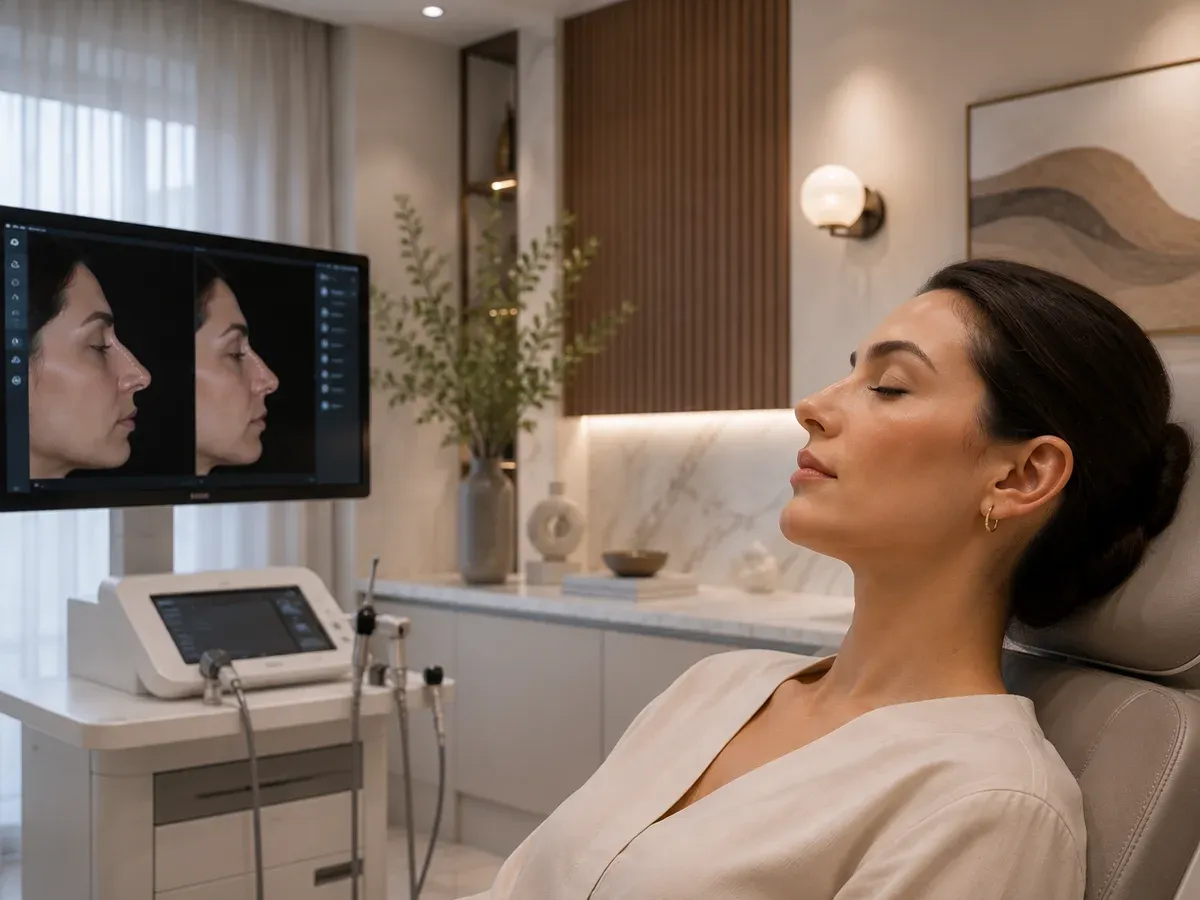
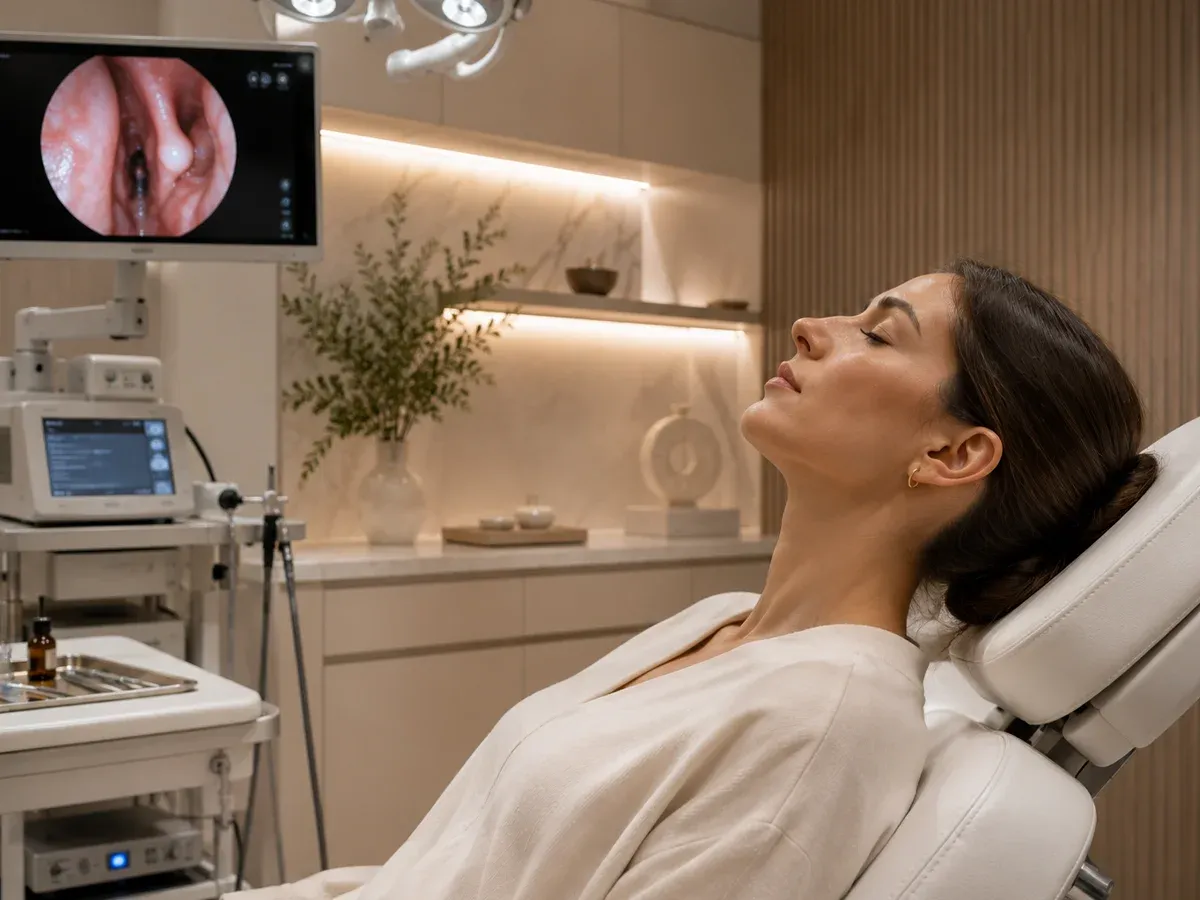
An endoscopic face lift repositions the brow and the midface through several short incisions hidden inside the hairline. A fine camera passed beneath the tissue projects a magnified view onto a monitor, so the surgery is carried out under direct vision without needing a long incision to see the anatomy.
It addresses the upper two-thirds of the face — the area that produces a heavy brow, a tired look around the eyes and a flattened cheek — rather than the jawline and neck.
What the procedure corrects
Ageing in the upper face is largely a matter of descent. The brow drops, crowding the upper eyelid and creating the impression of tiredness or severity even when the patient is rested. The malar fat pad slides downward off the cheekbone, flattening the midface and deepening the fold between nose and mouth.
An endoscopic lift releases these structures from their attachments and repositions them upward, restoring the position they held rather than stretching skin. Patients often report that people notice they look less tired without identifying that anything was done.
It does not correct jowling along the jawline or loose skin in the neck. Where those are the main concerns, a deep plane facelift is the appropriate operation.
How it is performed
The procedure is carried out under general anaesthesia and typically takes two to three hours.
Three to five incisions, each one to two centimetres long, are made within the hair. The endoscope is introduced through one while instruments work through the others. The tissue is elevated in a plane just above the bone across the forehead, and the periosteal attachments that tether the brow are released.
The elevated tissue is then fixed in its new position. Because the lift is held by fixation of deeper tissue rather than by removing scalp, the hairline is not drawn backwards — a limitation of the older coronal brow lift that this technique was developed to avoid.
Where the midface is included, the malar fat pad is released and suspended upward, restoring fullness over the cheekbone.
Suitability
The technique suits patients whose tissue still has reasonable elasticity and whose main concerns sit in the upper face. In practice this is often the late thirties to early fifties, though chronological age matters less than the pattern of change.
It is frequently combined with upper eyelid surgery, since brow position and eyelid skin are related — lifting a heavy brow sometimes reduces how much eyelid skin needs removing. Assessment considers both together, because operating on the eyelid alone in a patient with a descended brow can worsen the heaviness.
Patients with established jowling, significant skin laxity or a prominent neckline are better served by a lower face and neck procedure, and Dr. Dağlı will say so at consultation rather than offering a lesser operation.
Recovery
The head is elevated for the first few nights and cold compresses are used over the forehead and eyes. Swelling peaks around the second or third day and then declines steadily; bruising commonly tracks down toward the eyelids before fading.
Most patients are comfortable in public at around two weeks. Numbness across the scalp behind the incisions is expected and resolves over several months as small sensory nerves recover. Itching during that recovery is normal.
Strenuous exercise is avoided for three weeks, and sun protection is important during the first months.
For patients travelling to Antalya
Allow around ten days in Antalya. Sutures within the hairline are removed before you fly home, and the early result reviewed. Follow-up then continues remotely through photographs and video consultation at set intervals.