
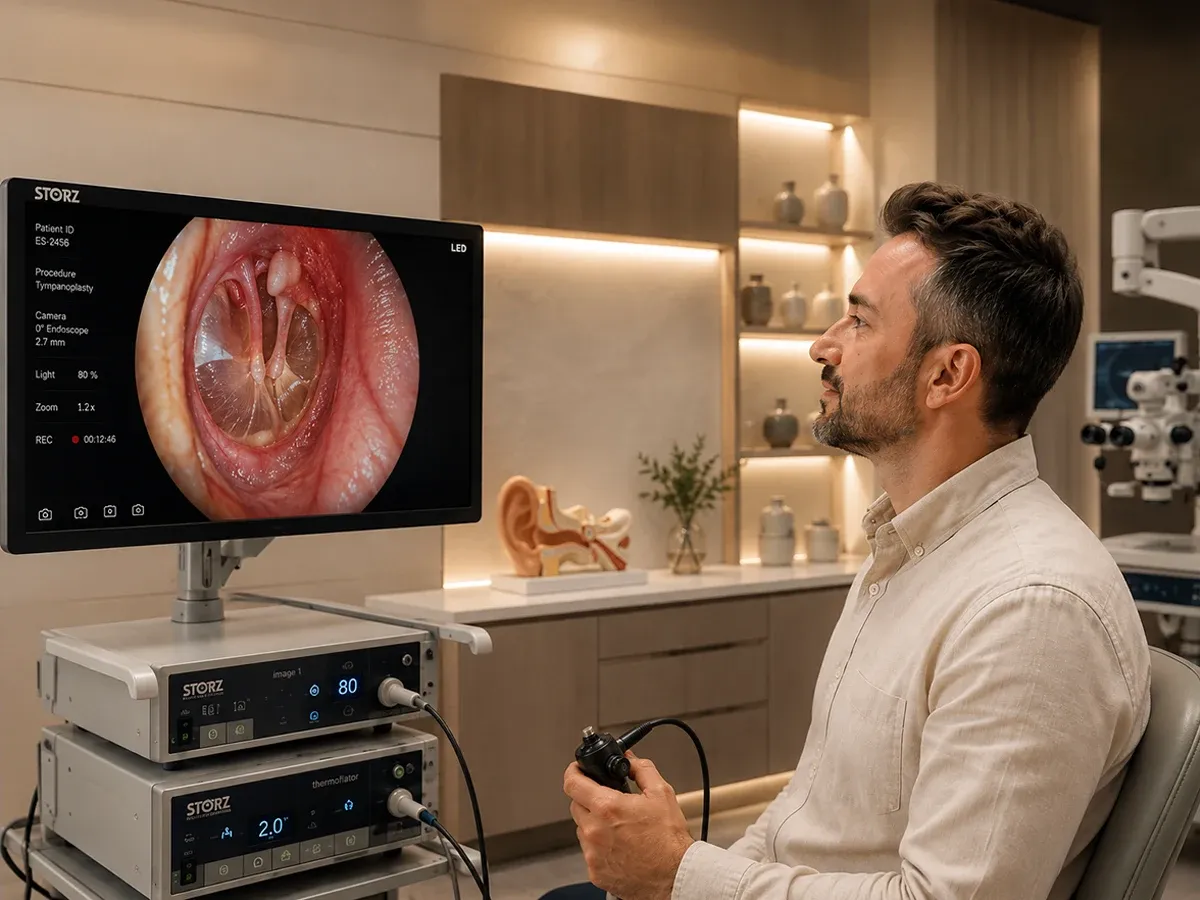
Ear surgery addresses structural problems inside the ear that hearing aids and medical treatment cannot resolve on their own — a perforated eardrum that will not heal, chronic infection driven by cholesteatoma, or a stapes fixed by otosclerosis. Dr. İsa Dağlı performs these procedures in Antalya as part of his ENT practice, with a particular focus on endoscopic technique where the anatomy allows it.
Endoscopic ear surgery
A rigid endoscope passed through the ear canal gives a wide-angle view of the middle ear, including recesses that are difficult to see in a straight line down a microscope — the sinus tympani and facial recess in particular, which is where cholesteatoma most often hides and recurs.
Where disease is confined to the middle ear, this view often allows the entire procedure to be done through the ear canal, without an incision behind the ear. Recovery is generally faster and more comfortable than the traditional approach, though not every case is suited to it — more extensive cholesteatoma, a very narrow ear canal, or the need for mastoid surgery still call for the open approach, sometimes combining both techniques in the same operation.
Cholesteatoma surgery
Cholesteatoma is an abnormal growth of skin trapped inside the middle ear, usually developing behind a retracted or perforated eardrum. It is not a tumour, but it behaves progressively: it sheds and accumulates debris, becomes chronically infected, and slowly erodes whatever bone it grows against.
Surgery has two goals that are not always achieved in one step. The first is safety — clearing disease from the middle ear, mastoid and any bone it has eroded, since untreated cholesteatoma can damage the facial nerve, the balance organs or, rarely, spread toward the brain. The second is hearing — reconstructing the eardrum and, where the chain of middle ear bones has been eroded, the ossicles themselves.
Because cholesteatoma can recur in the recesses it is hardest to inspect, many cases are followed with a planned second-look procedure a year or so after the first, or with interval MRI scanning designed specifically to detect recurrent disease without further surgery.
Tympanoplasty
Tympanoplasty repairs a perforated eardrum using a graft of the patient’s own tissue — typically taken from the fascia covering the temporalis muscle, or from cartilage behind the ear, both of which leave no visible scar. Closing the perforation protects the middle ear from water and infection and generally improves hearing, since an intact eardrum transmits sound far more efficiently than a perforated one.
Where cholesteatoma or chronic infection has also damaged the middle ear bones, tympanoplasty is combined with ossiculoplasty in the same operation.
Stapes surgery for otosclerosis
Otosclerosis is an inherited condition in which abnormal bone growth fixes the stapes — the smallest bone in the body, and the last in the chain that carries sound to the inner ear. A fixed stapes cannot vibrate, so sound transmission is progressively lost.
Stapes surgery (stapedotomy) removes the fixed portion of the bone and replaces it with a micro-prosthesis, restoring the moving connection to the inner ear. It is one of the most reliably effective operations in otology: in suitable candidates, hearing improvement is substantial and usually apparent within weeks.
Ossiculoplasty
Chronic ear disease and cholesteatoma can erode the chain of three small bones that carries sound across the middle ear. Ossiculoplasty reconstructs that chain, using the patient’s own remaining bone where possible or a synthetic prosthesis where it cannot be preserved. It is frequently performed alongside tympanoplasty or cholesteatoma surgery rather than as a standalone procedure.
Planning surgery from abroad
Patients travelling to Antalya for ear surgery are assessed remotely first, from a description of symptoms, any prior audiometry or imaging, and — where available — previous operative notes if this is a revision case. Cholesteatoma in particular benefits from CT imaging before travel, since it shows how far disease has spread and how the procedure should be planned. An in-person examination with microscopy or endoscopy and fresh audiometry always takes place before surgery is confirmed.
Because Dr. Dağlı practises both ear surgery and facial plastic surgery, patients attending for a nasal or facial procedure can have ear symptoms assessed at the same consultation. Nasal obstruction and Eustachian tube dysfunction are frequently related — see septoplasty where blocked breathing is also a concern.